
Overview
The Nikon Z9 was flown by NASA astronauts across 7 identified missions, in NASA service 2022–2026, contributing 2,214 identifiable frames to the public astronaut photography archive. Traced by manufacturer serial number, at least 29 physical bodies have been identified in the public archive. The Nikon Z9 was released by Nikon in December 2021.
Body S/N 3026738 is the most heavily documented in the archive, contributing 228 identifiable frames across 5 missions including ISS073, ISS071, ISS072. The other 28 identified bodies appear in more targeted mission windows, detailed below.
The Nikon Z9 bodies were used with a range of lenses in orbit — the most-used include the 14-24mm f/2.8G, VR 50-500mm f/4.5-6.3G, and NIKKOR Z 24-120mm f/4 S. The full lens roster appears in the sidebar.
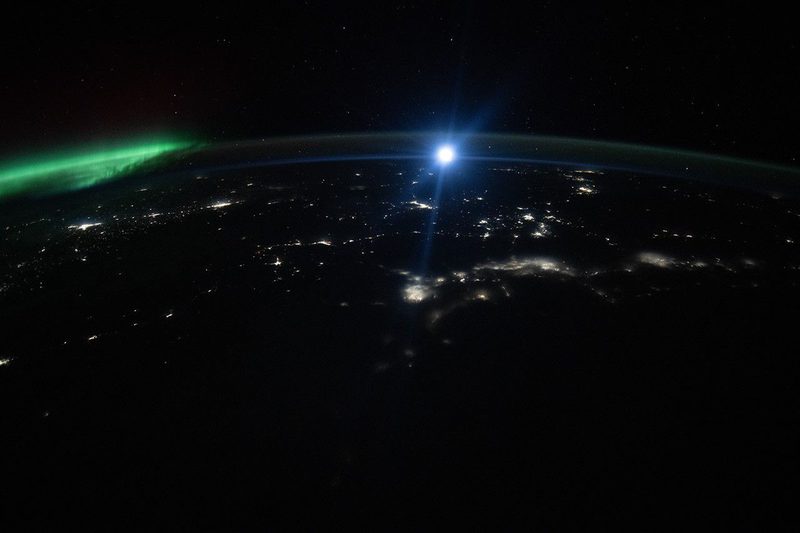
Exemplar photographs
Additional representative frames captured by the Nikon Z9 bodies in orbit. Full resolution is available at the linked NASA archives.
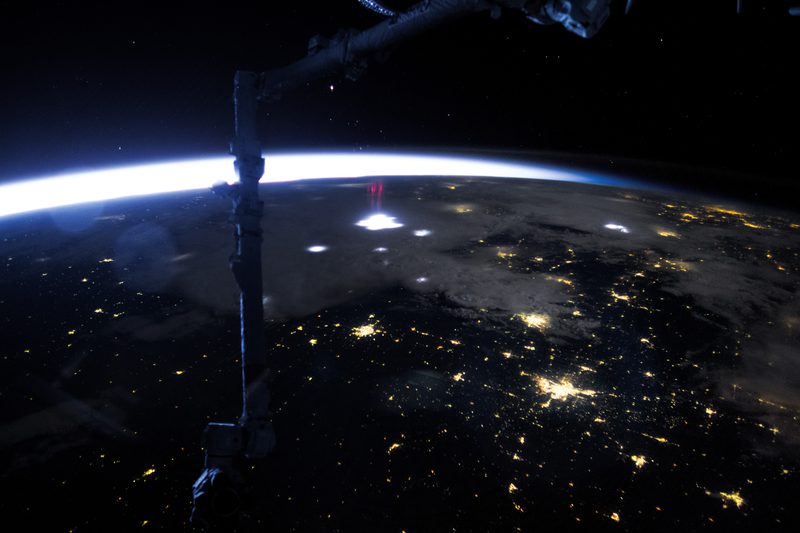
Sprites, Camera, Action (Rare Red Sprite captured)
In NASA service
The Nikon Z 9 became the first mirrorless camera in NASA's ISS Nikon inventory on 30 January 2024, when 13 Z 9 bodies, more than 15 NIKKOR Z lenses (including super-telephoto and micro lenses), and 15 FTZ II adapters were delivered aboard Northrop Grumman's CRS-20 resupply mission on a SpaceX Falcon 9 launched from SLC-40 at Cape Canaveral. The Z 9 is replacing the D5 and D6 inventory, with mechanical-autofocus lenses prioritized for replacement first.1
Nikon confirms that the flight Z 9 is physically unmodified from the commercial unit. All customization is in firmware: extended in-camera noise reduction to counter cosmic-ray sensor damage at fast shutter speeds; modified RAW file numbering to eliminate collisions across the hundreds of thousands of frames a crew captures per mission; default settings and controls optimized for ISS use and for EVA operation inside a protective covering; and modified in-camera FTP and transfer protocols to simplify astronaut workflow, increase throughput, and reduce power consumption when transmitting images to Earth.1 The Z 9 was Nikon's first camera to eliminate a mechanical shutter — the design uses an electronic shutter with a physical sensor protector — a choice Nikon cites as minimizing moving parts for durability.1
Astronauts Don Pettit and Matt Dominick, both active on ISS during 2024, have described operational specifics of the Z 9 in orbit. The camera's 14-bit RAW files provide roughly 14–15 stops of dynamic range in practice, and its two native ISOs give operators headroom to trade noise against dynamic range for different subjects. Long-exposure noise reduction operates by closing the sensor protector and capturing a matched dark frame at the same ISO and sensor temperature — a technique the crew relies on heavily to subtract cosmic-ray hot pixels from long-exposure star and aurora work. Named lenses in the current Z 9 kit include the NIKKOR Z 24 mm f/1.4, 28 mm f/1.4, 50 mm f/1.2 S, and a specially-funded 14 mm f/1.4 S; a 15 mm Arri Zeiss cinema lens (T/1.8) has also been adapted to the Z 9 body. The mid-1980s Noct-Nikkor 58 mm f/1.2 remains in operational use aboard the station.2
- Nikon Corporation. “Nikon Z 9 goes to space: Space station astronauts receive Nikon's flagship full-frame mirrorless camera.” Press release, 7 February 2024.
- Zakrzewski, Joseph. “The Art of Astronaut Photography” [interview with Don Pettit and Matt Dominick]. Houston We Have a Podcast, episode 397, NASA Johnson Space Center, 15 August 2025.
Commercial availability
Nikon Z9 on the used market
The bodies documented in this registry are the specific units NASA sent to orbit. The commercial market carries the same Nikon Z9 model at accessible prices for collectors, photographers, and researchers. Listings shown are the same model, not the specific bodies flown.
CARES LLC participates in the eBay Partner Network. Purchases via this link may generate commission at no additional cost to you. The listings shown are the same Nikon Z9 model used by NASA, not the specific bodies flown.
Bodies identified
Each identifiable body of the Nikon Z9 that appears in NASA's public astronaut photography archive, sorted by frame count.