
Overview
The Nikon D3S was flown by NASA astronauts across 30 identified missions, in NASA service 2010–2020, contributing 68,471 identifiable frames to the public astronaut photography archive. Traced by manufacturer serial number, at least 10 physical bodies have been identified in the public archive. The Nikon D3S was released by Nikon in October 2009.
Body S/N 2007931 is the most heavily documented in the archive, contributing 10,768 identifiable frames across 14 missions including ISS031, ISS030, ISS040. The other 9 identified bodies appear in more targeted mission windows, detailed below.
The Nikon D3S bodies were used with a range of lenses in orbit — the most-used include the 24.0 mm f/1.4, 28.0 mm f/1.4, and 400.0 mm f/2.8. The full lens roster appears in the sidebar.
Exemplar photographs
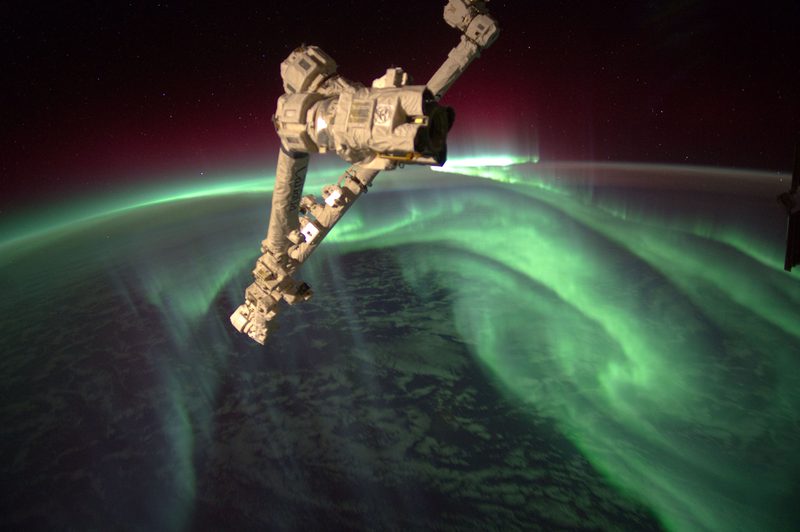
Additional representative frames captured by the Nikon D3S bodies in orbit. Full resolution is available at the linked NASA archives.
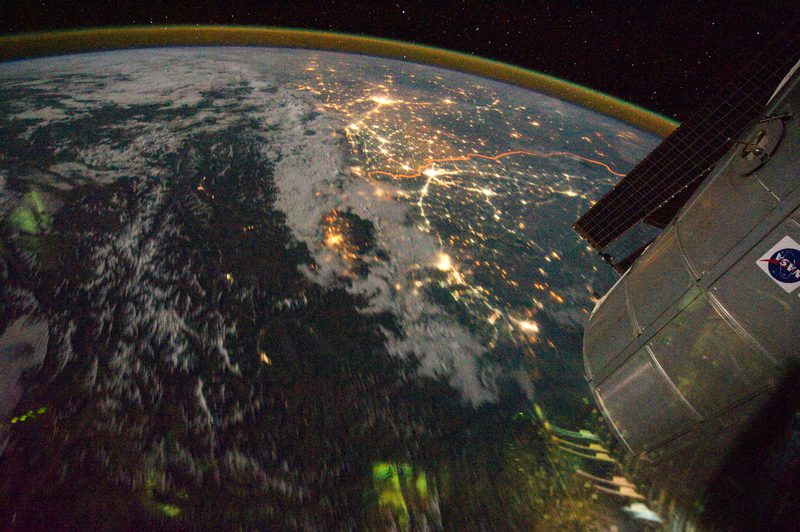
India-Pakistan Borderlands at Night
In NASA service
On 21 December 2009, Nikon Corporation announced that NASA had placed an order for 11 Nikon D3S bodies together with seven AF-S NIKKOR 14–24 mm f/2.8G ED lenses, intended for photographic documentation aboard the Space Shuttle and the International Space Station. Nikon explicitly stated that no special hardware modifications were made and that the flight units were the same product available to commercial customers — a marked departure from the D2Xs procurement two years earlier, which had specified strap-eyelet removal, Braycote lubrication, and dedicated firmware.1 Nikon's fiscal-year corporate reporting for the period independently records the 11-camera NASA order, and NASA's Cargo Mission Contract assigns the flight body a configuration-controlled hardware identifier, SEZ33121953.2
The 11 bodies were distributed to the flight programme over time rather than launched as a single batch. Nikon's 2010 technical retrospective records that only one D3S was actually aboard the ISS at that point, delivered by Discovery on STS-131 in April 2010 — the balance of the order supporting ground training, spares, and subsequent orbital rotations. The D3S was formally adopted by NASA in late 2009 and passed the same certification battery as the D2Xs it supplemented, entering service alongside the AF-S NIKKOR 14–24 mm f/2.8G ED as its standard companion lens.3
A widely circulated NASA photograph from Expedition 30/31 in 2011–2012 shows astronaut Don Pettit surrounded by Nikon cameras in the ISS microgravity environment; the frame captures the density of the Nikon fleet during the transition period between the D2Xs and D4 eras. Independent imaging-science analysis of NASA's D3s and D4 workflow published in 2017 characterizes ISS DSLR service life at six months to a year, driven by accumulated cosmic-ray damage to the sensor's pair-pixel readout structure.4
- Nikon Corporation. “Nikon Corporation to supply eleven D3S digital SLR cameras and seven AF-S NIKKOR 14–24 mm f/2.8G ED lenses to NASA.” Press release, 21 December 2009.
- Nikon Corporation, fiscal-year corporate reporting recording the NASA D3S order. NASA Cargo Mission Contract configuration-controlled hardware identifier
SEZ33121953assigned to CAMERA BODY, NIKON D3S. - Gotō, Tetsuro. “宇宙用ニコン・スペースカメラの開発” [Development of Nikon Space Camera]. Journal of the Society of Photographic Science and Technology of Japan 73, no. 2 (2010): 65–69.
- Moser, Kevin. “CRDIR: Cosmic Ray Damaged Image Repair for DSLR Cameras.” Rochester Institute of Technology, Center for Imaging Science Senior Project, May 2017.
Commercial availability
Nikon D3S on the used market
The bodies documented in this registry are the specific units NASA sent to orbit. The commercial market carries the same Nikon D3S model at accessible prices for collectors, photographers, and researchers. Listings shown are the same model, not the specific bodies flown.
CARES LLC participates in the eBay Partner Network. Purchases via this link may generate commission at no additional cost to you. The listings shown are the same Nikon D3S model used by NASA, not the specific bodies flown.
Bodies identified
Each identifiable body of the Nikon D3S that appears in NASA's public astronaut photography archive, sorted by frame count.